The Underground Railroad in Cincinnati remains a dominant and essential piece of history in Ohio.
Dr. Eric R. Jackson, Professor of History and Black Studies at Northern Kentucky University, presented the Underground Railroad information.
The Underground Railroad in Cincinnati shows enslaved African Americans’ courage, resilience, and unyielding pursuit of freedom. The challenging chapter in American history resonates deeply with residents and visitors, inspiring ongoing efforts for equality and justice.
Cincinnati’s role as a hub in the Underground Railroad shaped the city’s identity and defined its cultural landscape.
The Underground Railroad’s legacy remains vibrant and relevant in Cincinnati today, far from fading into the distant past. The 2004 opening of the National Underground Railroad Freedom Center brought the past to life, staking Cincinnati’s place in history. The world-class museum serves as a beacon, drawing thousands of visitors annually to explore the city’s rich abolitionist heritage.
The impact of the Underground Railroad extends far beyond the 19th century, influencing modern civil rights movements and community activism. Cincinnati’s Underground Railroad sites are reminders of the determination of those who fought against oppression. Countless accounts of bravery and perseverance have survived through the centuries, offering insights into this period of American history.
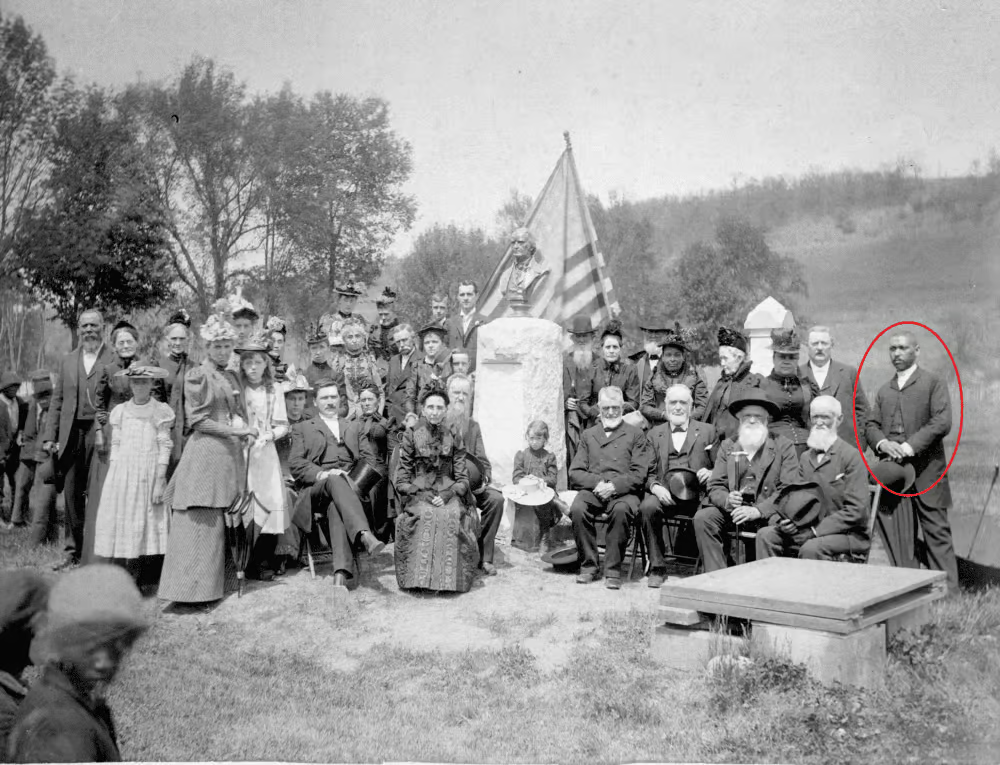
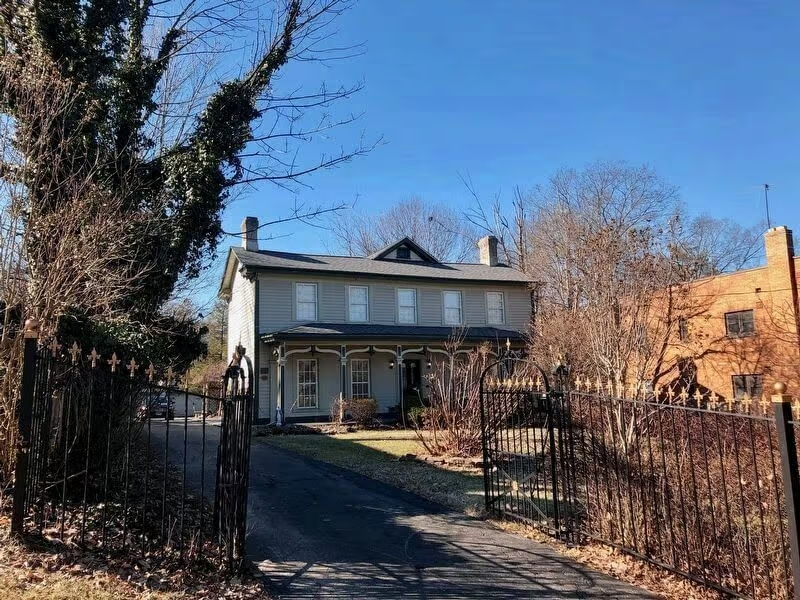
Photo Credit: VivianLowry.com, Ohio Historical Society, and John Parker House
The Story of John P. Parker
On a cloudy night in 1842, John P. Parker slowly boarded a ship docked in the harbor of New Orleans, Louisiana. Parker had known escaping enslavement was inevitable and had nurtured the objective for many years.
The Louisianan slave also tried to escape several times but failed. After hiding on the vessel for several hours, the ship began moving from the harbor towards the Mississippi River.
Along the way, young John enjoyed the scenery like a passenger on an ocean cruise to the Caribbean Islands. Parker’s latest attempt at gaining freedom eventually brought him to New Albany, Indiana, Cincinnati, Ohio, and Ripley, Ohio.
Once in Ripley, the white radical abolitionist Reverend John Rankin and Parker began helping thousands of African Americans gain freedom. During one venture, Parker recalled hiding among a wood pile on a New Orleans dock waiting to board a ship.
To learn more, visit the Urban Roots Podcast about John P. Parker in collaboration with Cincinnati Public Radio.

Photo Credit: WikiCommons
The Story of Henry Bibb
In 1835, Henry Bibb (known as “Walton” to the owner) made a first escape attempt. Bibb fled while being hired out by a neighbor named Mr. Vires in Newcastle, Kentucky. Although hoping to reach Canada easily, trackers captured, whipped, and isolated Bibb in less than twenty-four hours.
However, determined to obtain freedom, Bibb planned and executed another escape attempt, but the same result occurred. Slave catchers quickly recaptured him and whipped him again.
Bibb’s determination to escape was halted after meeting an enslaved African American woman named Malinda from a nearby plantation. Malinda would become Bibb’s wife.
Once married, Bibb soon became a father. However, the hardship of being separated from wife and child was unbearable. Bibb soon resolved to escape again.
After promising Malinda to return, Bibb absconded on Christmas Day in 1837.
When reaching Cincinnati, Ohio, with the help of several local African Americans, Bibb was introduced to a group of abolitionists. The new friends helped continue the travel further north through the Underground Railroad of Cincinnati to Perrysburg, Ohio.
Bibb stayed in Perrysburg for several months before returning to Kentucky to free Malinda and child. Bibb developed a plan to help them escape by steamship via the Ohio River.
Related Article: Black History in Cincinnati
Unfortunately, Bibb’s family failed to reach the rendezvous point on time. A slave catcher posing as an abolitionist recaptured Bibb and shipped him to Louisville, Kentucky, to be traded. However, Bibb managed to once again escape from capture.
After escaping, Bibb traveled to central Ohio, but several years later, in 1839, the loving father and husband returned to Kentucky to try to free the family. Again, slave catchers recaptured him and shipped him to Louisville. To try and quell future attempts, the slave owners sent the family all together to prevent another escape attempt.
Furthermore, several months later, authorities placed Bibb and family, along with several hundred enslaved African Americans, on a steamship that left Louisville, bound for Vicksburg, Tennessee, and eventually New Orleans, Louisiana.
While in New Orleans, during 1840, traders separated the Bibb family, selling the women to local gamblers and Bibb to a local Native American. However, the following year, in 1841, Bibb escaped from the Native Americans for good this time, traveled to the Mississippi River, and then secretly climbed aboard a steamboat en route to Portsmouth, Ohio.
By the late 1840s, Bibb had concluded that Malinda and the child would never be seen again. As a result, Bibb remarried in 1848 and became an ardent African American abolitionist in several New England and Middle Atlantic states over time.
As an abolitionist, Bibb published an autobiography titled “Narrative of the Life and Adventures of Henry Bibb, An American Slave,” Written by Himself in 1849 to tell the story to a broader audience. In 1849, the husband and wife published the first African American newspaper in Canada, Voice of the Fugitive.
The Story of Delia Webster and Calvin Fairbanks
During the decade, several individuals engaged in numerous Underground Railroad activities in other parts of the Bluegrass state. For example, Delia Webster and Calvin Fairbanks emerged as fiery abolitionists and Underground Railroad activists.

Photo Credit: https://stories.cincinnatipreservation.org/files/show/414

Photo Credit: https://explorekyhistory.ky.gov/files/show/551
Webster was born in Vermont in 1817, studied briefly at Oberlin College in Ohio, and moved to Kentucky in 1842. Fairbanks was born in New York in 1816, studied for several years at Oberlin College, and eventually became a Methodist minister. Although Webster and Fairbanks went to Oberlin, the young African Americans only crossed paths once on the Underground Railroad in Kentucky.
While traveling in Kentucky, Fairbank solicited funds and Webster’s assistance in need of additional funds.
Eventually, Fairbanks and Webster helped Lewis Hayden, an enslaved African American waiter, obtain liberation via the Underground Railroad.
However, upon hearing about the successful escape of Hayden, numerous slave catchers and law enforcement officers began monitoring the activities of Fairbanks and Webster, eventually leading to an arrest in 1844 en route to Lexington, Kentucky.
A Fayette Circuit Court convicted and sentenced two individuals to five and two years in jail, respectively, for helping hundreds of enslaved African Americans obtain freedom using the Underground Railroad. However, outraged by the jailing of a woman, on February 24, 1845, Governor William Owsley pardoned Webster. However, Fairbanks served most of the five-year term until Governor John Crittenden pardoned him on August 28, 1849.

Courtesy of https://susquehannavalley.blogspot.com/
The Story of the Bell Family
During the same period, in southeastern Indiana, many individuals spent many years helping enslaved African Americans gain freedom. More specifically, residents suspected the Bell family, Virginia-born whites from Brandenburg, Kentucky, of being abolitionists and thus aiding hundreds of enslaved African Americans to gain freedom.
For example, on a rainy day in 1857, Charles Bell, one of the sons, along with a former enslaved African American named Oswald Wright, aided a group of runaway Black Americans in the quest for freedom, weaving themselves in the history of the Underground Railroad in Cincinnati.
Conclusion
The journeys, activities, and comments of individuals like Parker, Henry Bibb, Delia Webster, Calvin Fairbanks, and the Bells are just a few examples of the experiences of thousands of enslaved Black Americans who decided to emancipate themselves from the horrible system of human bondage.
Travelers on the path to freedom found it complicated, complex, lengthy, mysterious, terrifying, exciting, dangerous, and exalting. But, in the end, it was worth it for those willing to try to escape.
The quest for freedom became more complicated after the American Revolution when numerous states enacted harsher pro-slavery laws. The United States Constitution was ratified with a provision that protected the institution of enslavement from any interference from the federal government.
Related Article: Black Roots in West End
Furthermore, the passage of the Fugitive Slave Acts of 1793 and 1850 not only gave slaveholders the right and ability to pursue and recapture runaway African Americans anywhere in the United States, but these laws also made it a crime for anyone who assisted enslaved persons of color in any escape activities.
Despite enacting these decrees, many people, African Americans, non-African Americans, rich and poor, Christians and non-Christians, women and men, consistently broke the law to assist Black Americans in the quest for freedom from the institution of enslavement.
Many people retain a shared vision of this topic and period in American history: one, two, three, or four fugitive enslaved persons of color receiving assistance escaping from one or two well-meaning, progressive whites, especially Quakers, to ultimately gain freedom.
Such episodes did not occur without question, but an abundance of historical evidence demonstrates that hundreds of Free Black Americans and former enslaved African Americans, especially in Cincinnati, aided numerous enslaved African Americans in finding freedom.
Related Article: Racial Tensions in OTR
For example, John Mercer Langston, born free in 1829 in Louisa County, Virginia, was the youngest child of four children. Ralph Quarles, a wealthy white planter and slaveholder, fathered him, and Lucy Langston, an emancipated woman of Indian and African descent, mothered him. When John turned fourteen, the young Langston enrolled in Oberlin College in Ohio and became an outstanding debater.
Several years later, in 1849, Mercer became the fifth African American male to graduate from Oberlin. Inspired by some elderly African American Cincinnatians, Langston moved to Cincinnati, Ohio.
During the 1830s and 1840s, the Black graduate decided to get active in the Underground Railroad by establishing safe houses throughout Cincinnati.
Another individual whose journey would end up in Harriet Beecher Stowe’s Uncle Tom’s Cabin was Eliza Harris, as many scholars have noted, on a cold, windy winter day in 1838, upon hearing that the owner, John G. Bacon, who lived in Mason County, Kentucky, was experiencing some financial troubles.
Usually, when finances were low, a slave would be sold, so Eliza Harris decided to act on a plan developed to escape with the two-year-old son across the river in Ohio and eventually to Canada.
Related Article: Stories of Black Kentuckians
Thus, with no detailed planning or other preparation, Harris slipped out for some air on one cold night with son and quickly traveled to the Kentucky side of the Ohio River. Harris found the river frozen with large broken ice pieces. Eliza jumped from ice plate to ice plate, with son on back, until reaching the Ohio River’s opposite shore.
Once in Ohio, Eliza traveled to the home of Reverend John Rankin, who lived in Ripley, Ohio. In Ripley, Reverend Rankin and Harris developed a detailed plan for the mother and child to reach Canada with little resistance.
Upon completing the plan, and after Harris had recovered from the horrible and deadly escape and traveling ordeal, Eliza journeyed to Cincinnati, Ohio, and then to Newport, Indiana. In Newport, with the help of the well-known Underground Railroad leader Levi Coffin, Harris went to Sandusky, Ohio, and eventually traveled to Canada.

Photo Credit: WikiCommons
In 1854, while visiting a populous Free African American community in Western Canada, the Coffin family accidentally encountered Harris and the son. On that day, the individuals expressed many greetings and happiness, embracing each other.
The Underground Railroad in Cincinnati
The National Underground Railroad Freedom Center tells many of these stories and displays numerous artifacts significant to the Underground Railroad.
In addition to these impactful stories, it is hard to dispute the depiction of scholars such as the late J. Blaine Hudson, Spencer Crew, and Prince Brown, who have depicted the Underground Railroad as the first multiracial, multi-class, multi-ethnic human rights movement in the United States that a person of African descent dominated.
Visit the National Underground Railroad Freedom Center to learn more about the history of the Underground Railroad in Cincinnati.
Join BCM Associate Archaeologist Jeannine Kreinbrink, as she delves into the haunting story of the Anderson Slave Pen and how the once-hidden structure played a central role in the 19th-Century slave trade. The structure can also be seen at The National Underground Railroad Freedom Center.
Recognizing Dr. Eric R. Jackson’s Contribution
Eric R. Jackson holds a doctorate from the University of Cincinnati and is a professor of history and Black studies in the Department of History and Geography at Northern Kentucky University. Jackson teaches American and African American history/studies, race relations, and peace studies courses.
As an expert in Black Studies, Jackson has over 50 publications, including articles in such journals as Africology: The Journal of Pan African Studies, Journal of African American History, and Journal of World Peace.
Hero Image Credit: James Michael Newell, Underground Railroad (1940), Smithsonian American Art Museum, Gift of the artist, 1980.56.17.
The Voice of Black Cincinnati is a media company designed to educate, recognize, and create opportunities for African Americans. Want to find local news, events, job postings, scholarships, and a database of local Black-owned businesses? Visit our homepage, explore other articles, subscribe to our newsletter, like our Facebook page, join our Facebook group, and text VOBC to 513-966-3328.